Introduction
Postural kyphosis, a flexible,
non-structural, and often reversible rounding of the upper back usually caused
by slouching, is commonly referred to as postural roundback, poor
posture, simply a slouched posture or arched back. It’s medical term is hyperkyphosis
and Dowager’s hump is often used for severe kyphosis in older individuals.
Postural kyphosis represents the most common cause of increased thoracic curvature in adolescents and young adults. Unlike structural deformities such as Scheuermann’s kyphosis, postural kyphosis is characterized by a flexible thoracic curve that arises from habitual slouching, prolonged sitting, muscle imbalance, and modern lifestyle factors including excessive screen use. With increased recognition of posture-related musculoskeletal problems across all age groups, understanding the pathophysiology, assessment strategies, and conservative treatment options for postural kyphosis has become increasingly relevant. A growing body of literature highlights the role of therapeutic exercise, postural training, sagittal balance analysis, and technological advancements in postural measurement. This review synthesizes current evidence regarding postural kyphosis based on fifteen key publications.
Epidemiology and Pathophysiology
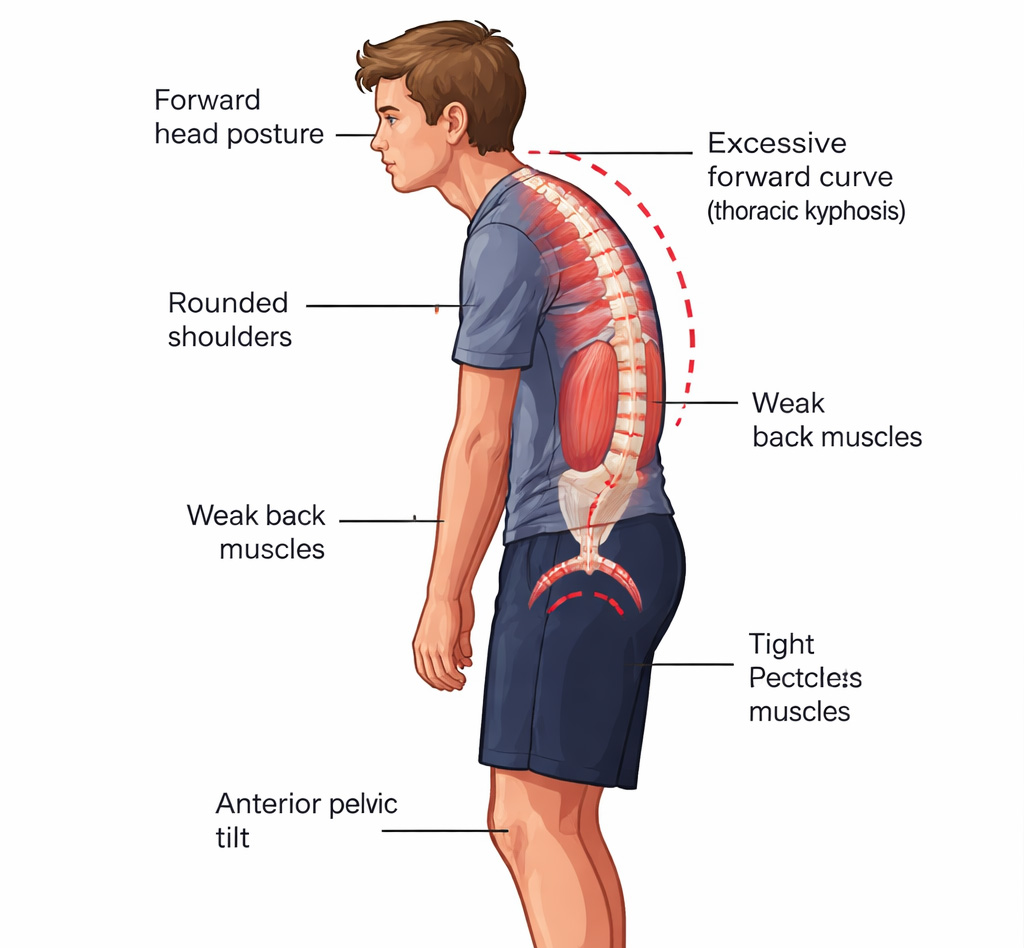
Postural kyphosis typically emerges during adolescence when rapid skeletal growth, muscle imbalance, and poor postural habits interact to create a flexible increase in thoracic curvature. Negri and Marenghi (1984) distinguish postural kyphosis from structural juvenile kyphosis, emphasizing its benign and reversible nature when addressed early (9). Increased sedentary behavior and prolonged use of digital devices have contributed to a rise in forward head posture, rounded shoulders, and thoracic hyperkyphosis, forming the clinical cluster commonly referred to as upper crossed syndrome (3).
Postural kyphosis differs from structural deformity in that vertebrae retain normal morphology. The curvature increases mainly due to prolonged flexion loading, weak thoracic extensors, tight pectoral musculature, and impaired neuromuscular postural control. Sagittal balance principles provide important insight into how thoracic kyphosis affects whole-body alignment. Le Huec et al. (2019) highlight that thoracic kyphosis and lumbar lordosis must harmonize to maintain global balance, with disruptions potentially altering the odontoid-hip axis angle and whole-body posture (2). Abelin-Genevois (2021) further notes that postural adaptations during growth can temporarily destabilize postural control, increasing susceptibility to postural curvature changes (4).
Assessment of Postural Kyphosis
Traditional assessment relies on visual inspection, forward-bend tests, and inclinometer or flexicurve measurements. However, recent advances have expanded measurement options.
Furlanetto et al. (2020) reported that Digital Image-based Postural Assessment (DIPA) provides valid sagittal-plane measurements for thoracic kyphosis, offering an accessible and non-invasive evaluation option (13). Similarly, Dilian et al. (2022) demonstrated that photogrammetry can quantify age-associated postural changes, suggesting potential application in early detection and longitudinal monitoring of postural kyphosis (14).
Khalifé et al. (2024) introduced full-body barycentremetry, demonstrating correlations between center-of-mass distribution and spinal alignment parameters (8). This method deepens understanding of compensatory mechanisms individuals use to maintain stability in the presence of increased thoracic kyphosis.
Conservative Management Strategies
Osteopathic manipulative treatment (OMT) provides a complementary approach for adolescents with postural kyphosis. Techniques such as myofascial release, soft tissue mobilization, muscle energy methods, and gentle spinal articulations aim to restore thoracic extension, balance muscular tension, and improve neuromuscular coordination. By addressing restrictions in the thoracic spine, scapulothoracic region, and associated soft tissues, OMT can reduce postural strain, enhance respiratory function, and facilitate postural retraining exercises. Integrating osteopathic interventions with structured exercise programs may accelerate postural correction and improve overall spinal alignment (16).
A 2024 systematic review by Porto et al. emphasized the importance of selecting specific exercises proven to improve postural alignment (1). Their analysis highlighted that targeted postural exercise programs produce significant improvements when they include spinal extension training, scapular stabilization, and mobility restoration.
Sepehri et al. (2024) conducted a systematic review and meta-analysis including individuals with forward head posture, rounded shoulders, and hyperkyphosis—features strongly associated with postural kyphosis. Therapeutic exercises significantly reduced thoracic kyphosis angle and improved upper-quarter alignment, supporting exercise-based rehabilitation as a primary intervention (3).
Resistance Band Programs
Abd-Eltawab and Ameer (2021) showed that Theraband-based training effectively improved thoracic posture in women with postural kyphosis, with equal or superior results compared to general active exercise (11).Downhill Treadmill Walking
Lee et al. (2024) found that downhill treadmill exercise reduces thoracic vertebral angle and modifies postural muscle activation, suggesting a novel, task-oriented approach to posture rehabilitation (10).Spine Strengthening and Posture Training
Although focused on older adults, Katzman et al. (2017) demonstrated that targeted spinal exercises can reduce kyphotic alignment and improve appearance and function (6). These findings may be extrapolated cautiously to younger populations.
Bradford (1977) and Pizzutillo (2004) provide essential foundational perspectives, noting that postural kyphosis responds well to exercise programs emphasizing thoracic extension, core stabilization, and hamstring flexibility (5,7). These early insights continue to guide modern therapeutic protocols.
Sagittal Balance and Biomechanical Considerations
Understanding sagittal balance is critical in managing postural kyphosis. Increased thoracic curvature can shift the center of mass anteriorly, prompting compensatory increases in cervical extension and lumbar lordosis. These compensations may contribute to neck pain, shoulder fatigue, and low-back stress.
Hinman (2004) reported that older women demonstrated greater thoracic kyphosis and increased stiffness compared to younger women, illustrating how aging may accentuate underlying postural imbalances (15). Though focused on older populations, these results highlight the importance of early intervention to prevent long-term postural deterioration.
Functional and Clinical Implications
Postural kyphosis may affect breathing efficiency, physical appearance, trunk endurance, and overall musculoskeletal health. Gordon et al. (2005) described challenges in positioning patients with severe kyphosis during cataract surgery, illustrating real-world impacts in clinical settings (12). While extreme cases are rare in postural kyphosis, functional consequences may accumulate if poor posture persists for years.
conclusion
Postural kyphosis is a highly prevalent, flexible spinal curvature commonly emerging during adolescence due to muscular imbalance, poor postural habits, and modern sedentary lifestyles. The recent literature demonstrates a robust evidence base supporting conservative management—especially targeted therapeutic exercises involving thoracic extension strengthening, scapular stabilization, resistance training, and neuromuscular re-education. Advances in digital posture assessment and barycentremetry have enhanced diagnostic precision, while studies on sagittal balance provide deeper understanding of whole-body compensations associated with increased kyphosis. Early recognition and structured rehabilitation yield excellent outcomes, reinforcing the importance of proactive management in youth to prevent progression into adulthood.
References
-
Porto AB, Nascimento Guimarães A, Alves Okazaki VH. Effect of postural exercises on postural alignment: a systematic review. J Bodyw Mov Ther. 2024 Oct;40:99–108. doi:10.1016/j.jbmt.2024.04.004. Epub 2024 Apr 13. PMID: 39593708.
-
Le Huec JC, Thompson W, Mohsinaly Y, Barrey C, Faundez A. Sagittal balance of the spine. Eur Spine J. 2019 Sep;28(9):1889–1905. doi:10.1007/s00586-019-06083-1. Epub 2019 Jul 22. PMID: 31332569.
-
Sepehri S, Sheikhhoseini R, Piri H, Sayyadi P. The effect of various therapeutic exercises on forward head posture, rounded shoulder, and hyperkyphosis among people with upper crossed syndrome: a systematic review and meta-analysis. BMC Musculoskelet Disord. 2024 Feb 1;25(1):105. doi:10.1186/s12891-024-07224-4. PMID: 38302926.
-
Abelin-Genevois K. Sagittal balance of the spine. Orthop Traumatol Surg Res. 2021 Feb;107(1S):102769. doi:10.1016/j.otsr.2020.102769. Epub 2020 Dec 13. PMID: 33321235.
-
Pizzutillo PD. Nonsurgical treatment of kyphosis. Instr Course Lect. 2004;53:485–491. PMID: 15116637.
-
Katzman WB, Vittinghoff E, Lin F, Schafer A, Long RK, Wong S, et al. Targeted spine strengthening exercise and posture training program to reduce hyperkyphosis in older adults: results from the SHEAF randomized controlled trial. Osteoporos Int. 2017 Oct;28(10):2831–2841. doi:10.1007/s00198-017-4109-x. Epub 2017 Jul 8. PMID: 28689306.
-
Bradford DS. Kyphosis. Clin Orthop Relat Res. 1977 Oct;(128):2–4. PMID: 598156.
-
Khalifé M, Vergari C, Assi A, Guigui P, Attali V, Valentin R, et al. Full-body postural alignment analysis through barycentremetry. Spine (Phila Pa 1976). 2024 Dec 1;49(23):1652–1660. doi:10.1097/BRS.0000000000005001. Epub 2024 Apr 4. PMID: 38571297.
-
Negri V, Marenghi P. [Juvenile kyphosis]. Acta Biomed Ateneo Parmense. 1984;55(2):113–118. PMID: 6234733.
-
Lee JH, Jeon HS, Park JH, Kim JH, Kwon OY, Choi WJ, et al. Effects of 4-week downhill treadmill walking on vertebral angle and postural muscle activity in participants with thoracic kyphosis and forward head posture: a comparative longitudinal study. J Back Musculoskelet Rehabil. 2024;37(3):707–713. doi:10.3233/BMR-230187. PMID: 38160339.
-
Abd-Eltawab AE, Ameer MA. The efficacy of Theraband versus general active exercise in improving postural kyphosis. J Bodyw Mov Ther. 2021 Jan;25:108–112. doi:10.1016/j.jbmt.2020.10.021. Epub 2020 Oct 26. PMID: 33714480.
-
Gordon MI, Rodríguez AA, Olson MD, Miller KM. Pillow case. J Cataract Refract Surg. 2005 Sep;31(9):1824–1825. doi:10.1016/j.jcrs.2005.01.019. PMID: 16246791.
-
Furlanetto TS, Candotti CT, Sedrez JA, Dutra VH, Vieira A, Loss JF. Concurrent validity of digital image-based postural assessment as a method for measuring thoracic kyphosis: a cross-sectional study of healthy adults. J Manipulative Physiol Ther. 2020 Feb;43(2):93–99. doi:10.1016/j.jmpt.2019.03.010. PMID: 32660713.
-
Dilian O, Kimmel R, Tezmah-Shahar R, Agmon M. Can we quantify aging-associated postural changes using photogrammetry? A systematic review. Sensors (Basel). 2022 Sep 2;22(17):6640. doi:10.3390/s22176640. PMID: 36081099.
-
Hinman MR. Comparison of thoracic kyphosis and postural stiffness in younger and older women. Spine J. 2004 Jul–Aug;4(4):413–417. doi:10.1016/j.spinee.2004.01.002. PMID: 15246302.
Licciardone JC, Gatchel RJ. Osteopathic manipulative treatment for musculoskeletal conditions in children and adolescents: a review of the evidence. J Am Osteopath Assoc. 2010 Mar;110(3):154–164. doi:10.7556/jaoa.2010.110.3.154. PMID: 20385746.