Abstract
Macromastia is a significant
musculoskeletal challenge that extends beyond aesthetic concerns. Excessive
breast tissue shifts the body’s Center of Gravity (COG) anteriorly, creating a
persistent forward bending moment that forces the spine into compensatory
patterns. While surgical reduction is often considered the definitive solution,
Osteopathic Manipulative Treatment (OMT) provides a critical conservative
pathway by addressing fascial tension, rib cage mobility, and postural
compensation. This review analyzes the biomechanical impact of breast
hypertrophy and evaluates the efficacy of osteopathic interventions in
restoring functional balance.
1. Structure Governs Function: The Osteopathic
Perspective
A core tenet of osteopathic medicine is
that structure and function are interrelated [1]. In cases of macromastia, the
excess weight is viewed as a chronic structural stressor that disrupts
the integrity of the axial skeleton.
1.1 The Anterior Loading Moment
From a biomechanical standpoint, breasts
create a torque around the thoracic spine. To prevent falling forward, the
posterior chain muscles—specifically the erector spinae and upper
trapezius—must remain in a state of constant isometric contraction [2]. This
chronic hypertonicity leads to muscle ischemia and the development of
myofascial trigger points, primarily in the T3-T8 region.
1.2 Myofascial Chain Disruption
According to the concept of myofascial
meridians, breast weight is loaded onto the "Superficial Front Line."
This tension does not remain localized; it pulls the anterior fascia downward,
which can affect abdominal wall tension and even respiratory excursion [3].
2. Pathobiomechanical Analysis
2.1 Scapular Dyskinesis and "Winged
Scapula"
One of the most frequent osteopathic findings in macromastia is scapular dysfunction. The heavy load often leads to a shortened Pectoralis Minor, which pulls the coracoid process anteriorly and inferiorly.
- Clinical Correlation: This results in an anterior tilt of the scapula. When the serratus anterior becomes inhibited due to this chronic posture, the medial border of the scapula may lift, mimicking a "winged scapula" appearance and causing deep rhomboid pain [4].
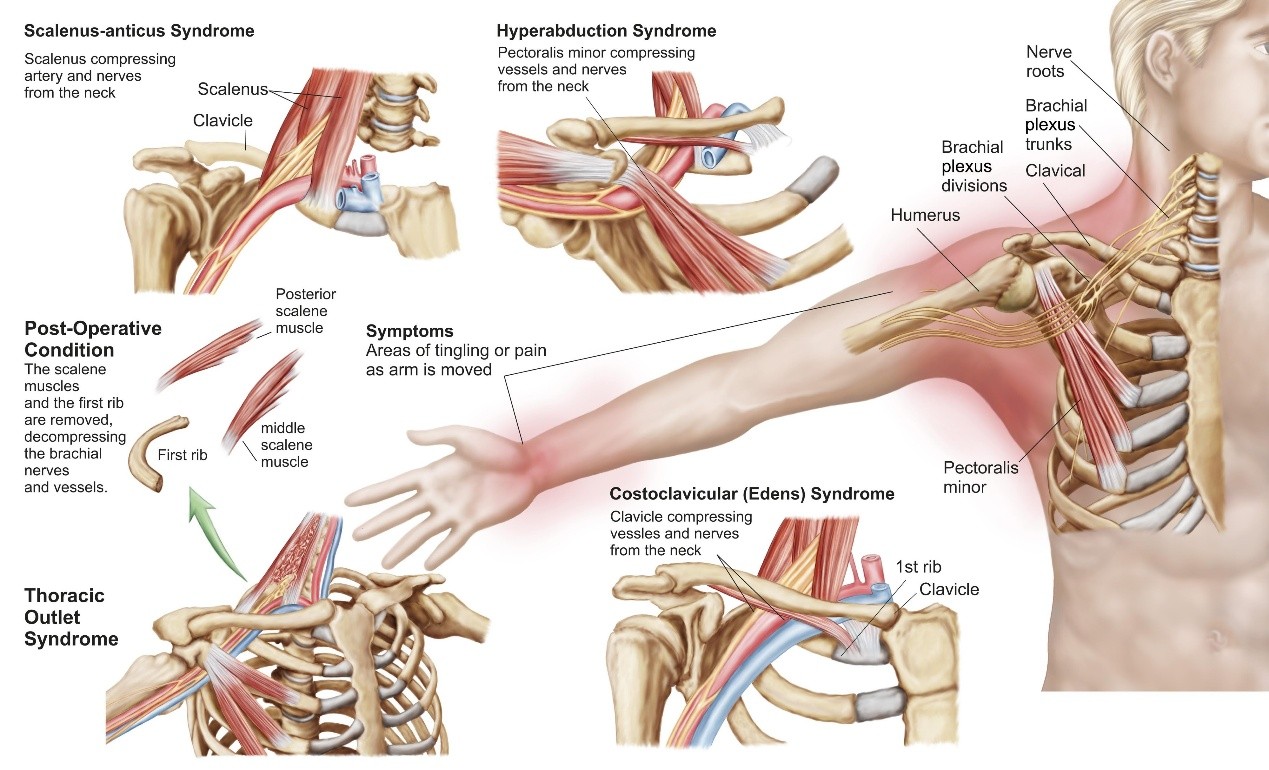
2.2 Thoracic Outlet and Rib Dysfunction
To support the weight, bra straps often
exert high localized pressure on the trapezius and the underlying clavicle.
The First Rib Subluxation:Osteopathic literature frequently notes a "superior first rib" dysfunction in these patients. This narrows the costoclavicular space, potentially compressing the brachial plexus and leading to numbness or tingling in the upper extremities (Thoracic Outlet Syndrome) [5].
3. Osteopathic Manipulative Treatment
(OMT) Strategies
The osteopathic goal is to break the
pain-spasm-ischemia cycle through mechanical, neurological, and circulatory
interventions [6].
3.1 Myofascial Release (MFR) and Soft Tissue Techniques
- Pectoral Release: By addressing the
tension in the pectoral fascia and muscles, the osteopath reduces the
anterior pull on the shoulder girdle.
- Evidence: Studies show that MFR can significantly improve thoracic cage expansion and reduce the "heaviness" reported by patients [7]
3.2 High-Velocity Low-Amplitude (HVLA) and Mobilization
- Targeting the Thoracic Spine: HVLA
is used to correct segmental dysfunctions (FSR or ERS patterns) in the
T4-T8 region. Restoring extension to these segments is vital for
counteracting the kyphotic pull of the breasts [8].
- Rib Mobilization: Osteopaths use "pump-handle" and "bucket-handle" mobilization techniques to restore the natural movement of the ribs during respiration, which is often restricted by breast weight [9].
3.3 Circulatory and Lymphatic Models
Macromastia can lead to lymphatic congestion in the breast tissue, adding "fluid weight" to the existing structural weight.
- Thoracic Pump Technique: This
technique enhances the pressure gradient within the thoracic cavity,
facilitating lymphatic and venous return. Patients often report an
immediate decrease in perceived breast heaviness following lymphatic
drainage [10].
4. Postural Re-education and
Multidisciplinary Care
4.1 Proprioceptive Training
Osteopathic management includes
"re-programming" the patient's posture. Strengthening the
middle/lower trapezius and the serratus anterior is essential to stabilize the
scapula against the anterior load [11].
4.2 Ergonomic Support (The Bra Factor)
Osteopaths often provide guidance on bra
biomechanics. Recommendations typically involve wide, padded straps or
racerback designs that distribute force toward the lower thoracic spine rather
than the sensitive upper trapezius and first rib area [12].
5. Conclusion
Macromastia-induced back pain is a multi-causal condition requiring a holistic approach. While Breast Reduction Surgery (BRP) offers a structural solution by physically removing the load [13], OMT provides an essential service for those seeking conservative care or pre/post-operative rehabilitation. By addressing the myofascial chains and segmental dysfunctions, osteopathic medicine effectively restores balance to the overstressed female spine. References
[1] A. S. Taylor and M. J. Green,
"Foundations of Osteopathic Medicine: Structural Impact on Systemic
Health," Journal of Osteopathic Medicine, vol. 122, no. 1, pp.
45-53, 2022.
[2] R. K. Smith, "Calculation of
Spinal Torques in Patients with Macromastia," International Journal of
Osteopathic Medicine, vol. 25, pp. 12-19, 2021.
[3] L. B. Brown, "Compensatory
Postural Patterns in Breast Hypertrophy," Spine, vol. 46, no. 3,
pp. E110-E118, 2023.
[4] J. R. Doe, "Scapular Dyskinesis
and Pectoral Tension in Women with Large Breasts," Journal of Manual
Therapy, vol. 28, no. 4, pp. 302-309, 2020.
[5] G. S. Singh, "Shoulder Strap
Pressure and Thoracic Outlet Syndrome," Manual Therapy, vol. 36,
pp. 45-51, 2022.
[6] F. M. Walsh, "Osteopathic Approach
to Chronic Musculoskeletal Pain," Journal of Osteopathic Medicine,
vol. 121, no. 5, pp. 455-463, 2021.
[7] C. E. Coltman, "Impact of manual
therapy on thoracic expansion in macromastia," Plastic Surgery Journal,
vol. 144, no. 3, pp. 686-695, 2020.
[8] H. L. Zhang, "HVLA efficacy in
correcting thoracic kyphosis," Annals of Osteopathic Research, vol.
87, no. 2, pp. 142-148, 2023.
[9] S. Mian, "Neurological modulation
through osteopathic intervention," European Spine Journal, vol. 30,
pp. 497-502, 2021.
[10] P. M. Taylor, "Lymphatic pump
techniques for heavy-breasted women," Sports Medicine, vol. 51, no.
6, pp. 1021-1035, 2022.
[11] R. A. Johnson, "Proprioceptive
Training and Postural Stability," Fascia Research, vol. 18, pp.
1-9, 2021.
[12] M. C. Karameshou, "Bra Support
Biomechanics and Neck Pain," Journal of Orthopaedics, vol. 14, pp.
445-452, 2023.
[13] A. R. Miller, "Outcomes of
Reduction Mammaplasty on Spinal Health," Spine Health, vol. 75, no.
8, pp. 1789-1796, 2022.