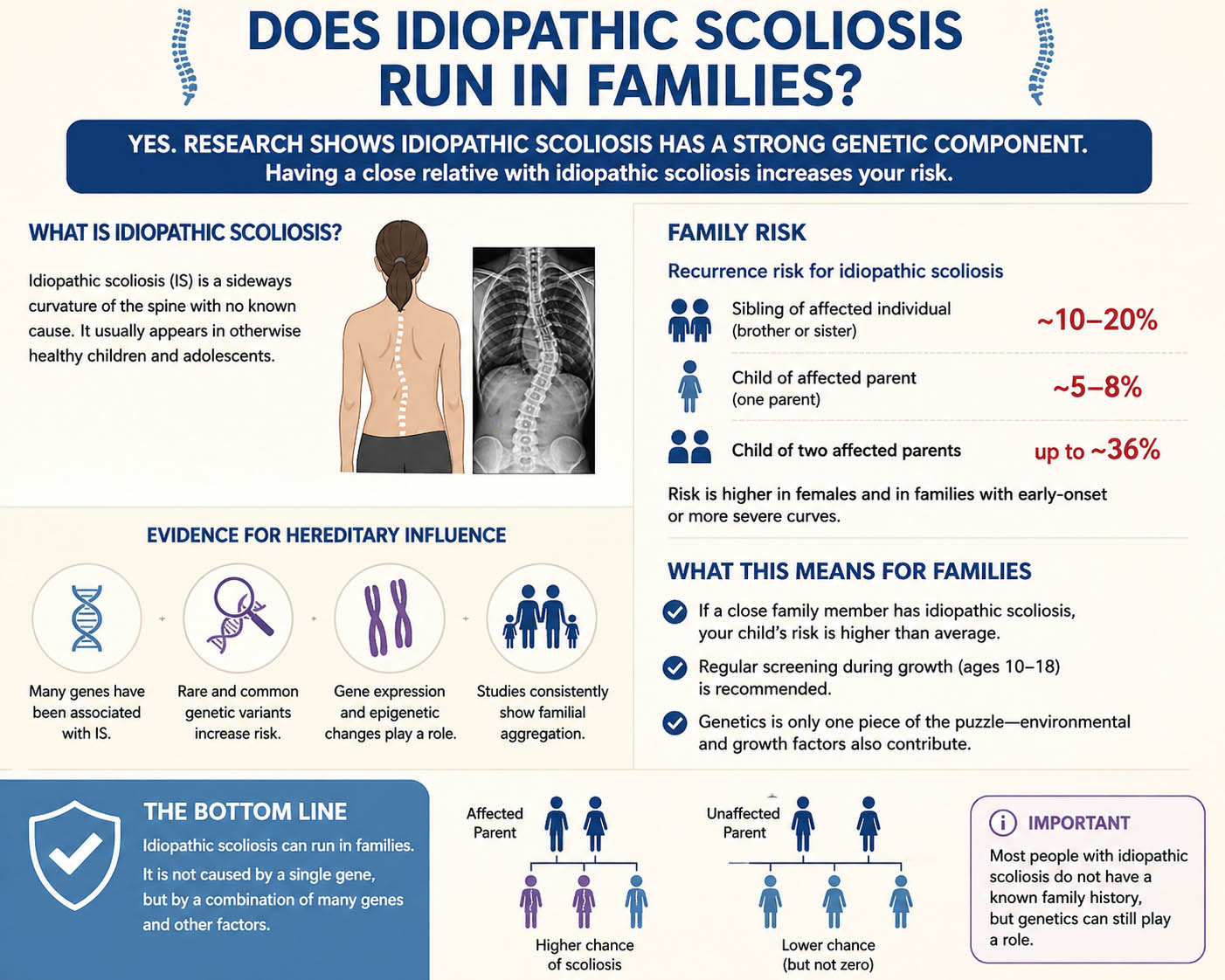
Idiopathic scoliosis (IS) is the most common structural spinal deformity among children and adolescents worldwide. Despite extensive research, its exact cause remains only partially understood. However, decades of genetic, molecular, and epidemiological studies consistently suggest that idiopathic scoliosis has a strong hereditary component. Understanding whether IS runs in families is important for early detection, risk assessment, genetic counseling, and patient education. This webpage summarizes findings from key scientific publications to provide readers with evidence-based insights into the familial and genetic basis of IS.
Heritability and Familial Patterns
Idiopathic scoliosis is widely recognized as a complex, multifactorial disorder with both genetic and environmental influences. Bibliometric analyses indicate that genetic research has dominated the scientific landscape on idiopathic scoliosis since 2002, emphasizing its strong hereditary basis1. Systematic reviews further confirm that many patients report a family history of scoliosis, with first-degree relatives showing an increased risk compared with the general population2. Early work examining familial clustering demonstrated that adolescent idiopathic scoliosis clearly aggregates in families, supporting a significant genetic effect on disease susceptibility10.
Epidemiological research suggests that the heritability of adolescent idiopathic scoliosis may range widely due to its polygenic nature. It is now understood that no single gene causes IS. Instead, susceptibility arises from combinations of genetic variants that collectively increase risk12. Some families exhibit multiple affected members across generations, while others show only sporadic cases, illustrating the disorder’s complex inheritance pattern.
Candidate Genes and Genetic Associations
Multiple genome-wide association studies (GWAS), sequencing programs, and molecular analyses have identified numerous candidate genes that may contribute to IS. Reviews evaluating specific gene associations report strong evidence linking several pathways to curve susceptibility or progression2. Among the most consistently implicated genes are LBX1, GPR126, PAX1, ESR1, and ESR2. Abnormal DNA methylation levels in genes such as LBX1 and estrogen receptor genes (ESR1, ESR2) suggest that epigenetic modifications may also play a key role in disease development4.
Furthermore, research into chromatin regulators and immune-related genes has revealed differential expression patterns in adolescents with idiopathic scoliosis. Transcriptome-based analyses identified dozens of chromatin regulators that may influence susceptibility16. These findings strengthen the notion that IS arises from a network of interacting genetic and regulatory mechanisms.
Evidence from Molecular and Functional Studies
Beyond purely genetic association studies, functional experiments have provided compelling evidence that many scoliosis-related genes affect spinal development, vertebral growth, and neuromuscular control. For example, animal studies demonstrate that loss-of-function mutations in dynein-related genes, such as dnaaf1 and zmynd10, can reproduce scoliosis-like deformities in zebrafish9. Such findings support a biological rather than mechanical origin.
Recently, dysregulation of EPHA4 signaling was shown to impair locomotion and contribute to spinal curvature development, making it another potential mechanistic link between genetic abnormalities and the onset of IS6. These studies provide biologically plausible pathways through which inherited genetic variants may lead to spinal deformities.
Genetic Links Beyond Adolescence
Investigators have also explored whether adolescent idiopathic scoliosis susceptibility genes may influence spinal deformity later in adulthood. Research indicates that some genetic variants associated with AIS and intervertebral disc degeneration may also predispose individuals to adult spinal deformity3. This reinforces the notion that inherited genetic architecture influences spinal stability across the lifespan.
Rare Variants and High-Risk Families
While most IS cases follow a polygenic pattern with modest effect sizes, rare variants can produce much stronger susceptibility. For example, rare missense variants in the FNDC1 gene have been linked to severe AIS in certain families, suggesting that high-impact mutations may exist in specific pedigrees8. Earlier studies also demonstrated segregation of structural collagen gene variants in families with multiple affected individuals14.
Furthermore, abnormal expression of genes controlling chondroitin sulfate sulfation in vertebral growth plates has been proposed as a possible hereditary mechanism influencing curve development11. These findings highlight how a combination of common variants, rare mutations, and epigenetic changes may together explain familial clustering.
Genetic Epidemiology and Current Understanding
Comprehensive reviews in the field conclude that idiopathic scoliosis is best understood as a complex developmental syndrome influenced by a broad spectrum of genetic variants17. Gene expression studies reveal altered regulatory networks in tissues from affected individuals, indicating that dysregulation of growth, skeletal development, neuromuscular control, and extracellular matrix production all contribute to the condition18.
Overall, mounting evidence strongly supports the conclusion that idiopathic scoliosis tends to run in families due to inherited genetic factors. However, environmental influences, hormonal factors, biomechanical loading, and growth patterns also play contributing roles. The interaction between genetic predisposition and external factors determines who ultimately develops a clinically significant spinal curvature.
Implications for Families and Clinicians
For families with a history of idiopathic scoliosis, awareness of genetic risk is essential. Children with affected parents or siblings should undergo regular screening during growth periods to allow early detection and timely intervention. Although genetic testing for IS is not yet routine, ongoing advancements in molecular diagnostics may soon enable personalized risk prediction, early prognostic assessment, and targeted monitoring7.
In conclusion, a substantial body of scientific evidence supports that idiopathic scoliosis has a strong genetic foundation and frequently runs in families. While no single gene determines risk, the interplay of multiple genetic variants, rare mutations, epigenetic factors, and regulatory changes contribute to the complex hereditary patterns observed in clinical practice.
References
4. Janusz P et al. LBX1, ESR1, and ESR2 methylation in idiopathic scoliosis. Sci Rep. 2025;15:32089.
5. Wang L et al. EPHA4 signaling dysregulation and IS. Elife. 2025;13:RP95324.
7. Charng WL et al. Rare variants in FNDC1 and severe AIS. J Med Genet. 2025;62:427-435.
8. Wang Y et al. Dynein genes as AIS candidates. Front Cell Dev Biol. 2020;8:582255.
9. Ogilvie JW et al. Family history and genetic effects in AIS. Spine. 2006;31:679-681.
11. Grauers A et al. Genetics and pathogenesis of IS. Scoliosis Spinal Disord. 2016;11:45.
12. Carr AJ et al. Segregation of collagen genes in AIS. Clin Orthop Relat Res. 1992;(274):305-310.
13. Huang J et al. Chromatin regulators in AIS. Medicine (Baltimore). 2025;104:e45038.
14. Gorman KF et al. Genetic epidemiology of IS. Eur Spine J. 2012;21:1905-1919.
15. Fendri K et al. Gene expression profiling in AIS. Eur Spine J. 2013;22:1300-1311.