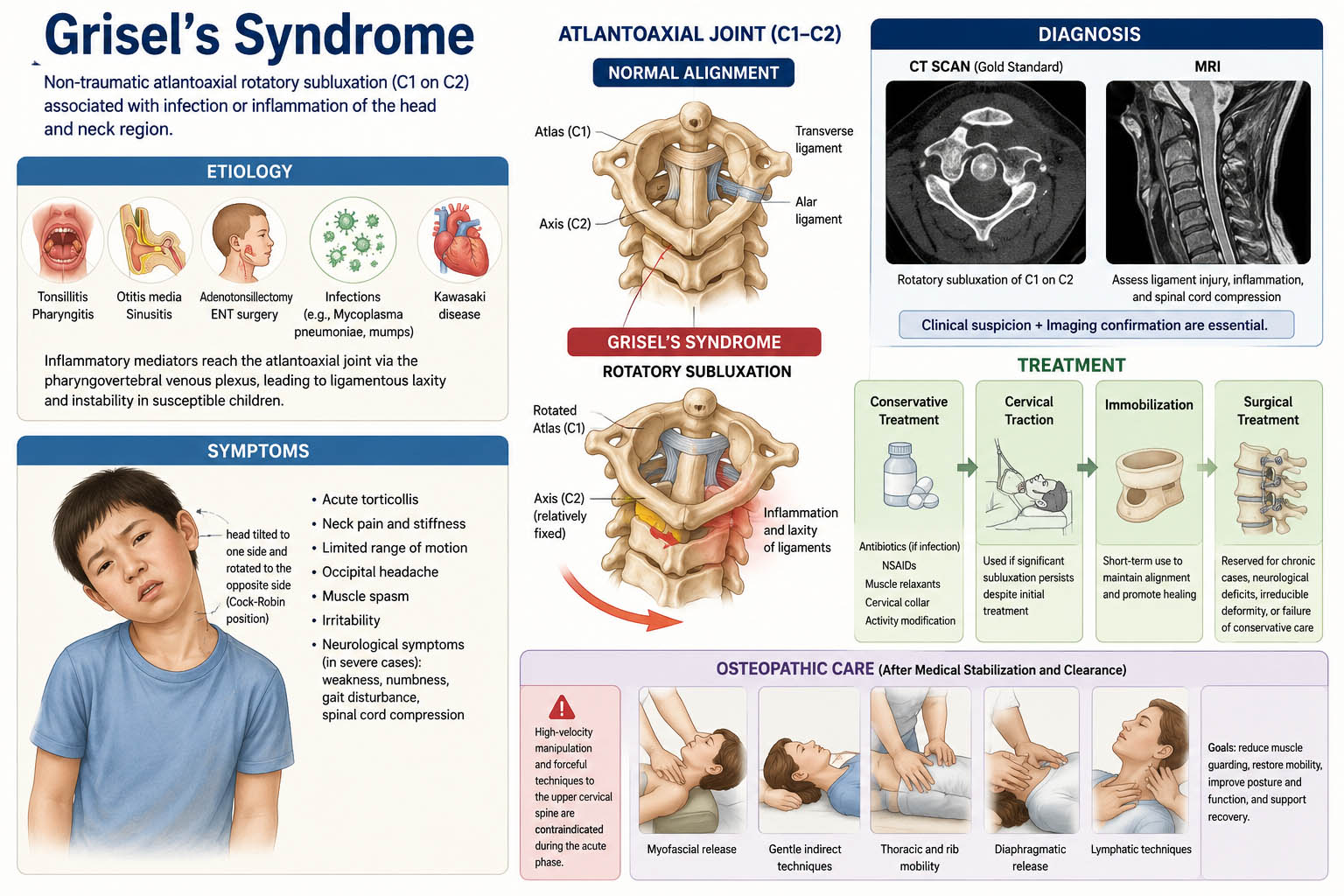
Grisel’s syndrome is a rare but potentially serious condition characterized by non-traumatic atlantoaxial rotatory subluxation (AARS), involving abnormal rotation or displacement between the first cervical vertebra (atlas, C1) and the second cervical vertebra (axis, C2). Unlike traumatic cervical instability, Grisel’s syndrome develops secondary to inflammation or infection in the head and neck region, often following upper respiratory tract infections or otolaryngological procedures.2
Etiology and Pathophysiology
The most widely accepted mechanism is the “two-hit hypothesis.” First, children naturally possess greater ligamentous laxity at the atlantoaxial joint. Second, inflammatory mediators spread from the pharyngeal region through the pharyngovertebral venous plexus, causing hyperemia, edema, and weakening of the transverse and alar ligaments stabilizing C1 and C2.27
This combination of ligamentous laxity and inflammation may result in atlantoaxial rotatory subluxation without any traumatic event.5
Risk Factors
Several factors increase susceptibility to Grisel’s syndrome:
Clinical Symptoms
The hallmark symptom of Grisel’s syndrome is acute torticollis, often developing several days after infection or surgery.13
Common symptoms include:
- Painful neck stiffness
- Restricted cervical motion
- Head tilted to one side and rotated to the opposite side (“Cock-Robin” posture)20
- Occipital or upper cervical pain
- Muscle spasm of the sternocleidomastoid muscle
- Difficulty turning the head
- Fever or recent history of infection
More severe cases may present with:
- Neurological deficits
- Upper extremity weakness
- Sensory disturbances
- Spinal cord compression
- Respiratory compromise in extreme cases18
Children frequently present with persistent torticollis that fails to improve despite standard treatment for muscle strain.8
Diagnosis
Diagnosis requires a combination of clinical suspicion, physical examination, and imaging studies.
Clinical Assessment
Clinicians should suspect Grisel’s syndrome when painful torticollis develops following:
Physical Examination
- Abnormal head posture
- Marked restriction of cervical rotation
- Painful neck movement
- Muscle guarding and spasm
- Neurological examination to assess spinal cord involvement
Imaging Studies
Computed tomography (CT) is considered the gold standard for confirming atlantoaxial rotatory subluxation.8 CT accurately demonstrates rotational displacement and allows classification of the severity.
Magnetic resonance imaging (MRI) is useful for evaluating:
- Ligament injury
- Inflammatory changes
- Spinal cord compression
- Retropharyngeal infection15
Plain radiographs may identify gross instability but are generally less sensitive than CT imaging.2
Differential Diagnosis
Conditions that may mimic Grisel’s syndrome include:
- Congenital muscular torticollis
- Cervical muscle strain
- Cervical disc pathology
- Traumatic atlantoaxial instability
- Retropharyngeal abscess
- Meningitis
- Cervical tumors
- Juvenile idiopathic arthritis
Medical Treatment
Treatment depends on the severity and duration of symptoms.
Conservative Management
- Appropriate antibiotic therapy for underlying infection
- Nonsteroidal anti-inflammatory drugs (NSAIDs)
- Muscle relaxants
- Soft cervical collar
- Bed rest and activity modification
Early diagnosis is associated with excellent outcomes and lower risk of chronic instability.20
Cervical Traction
Patients with persistent subluxation may require cervical traction to restore normal alignment.8 Traction is typically performed under specialist supervision and followed by immobilization.
Surgical Treatment
Surgery may be necessary when:
- Conservative treatment fails
- Subluxation becomes chronic
- Neurological deficits develop
- Severe instability is present18
Surgical options include:
- Posterior cervical fusion
- Internal fixation
- Reduction of atlantoaxial displacement
Osteopathic Treatment Considerations
Osteopathic assessment may be valuable during the rehabilitation phase after the atlantoaxial instability has been medically stabilized and cleared by the treating physician. Osteopathic treatment is not intended to reduce an active atlantoaxial subluxation and should never replace emergency medical management.
During the acute stage, direct cervical manipulation, high-velocity low-amplitude (HVLA) techniques, and forceful rotational procedures are contraindicated because of the risk of worsening instability or neurological injury.
Appropriate Osteopathic Approaches After Stabilization
- Gentle myofascial release of cervical and thoracic soft tissues
- Balanced ligamentous tension techniques
- Indirect functional techniques
- Rib cage mobility restoration
- Thoracic spine mobility improvement
- Diaphragmatic release and respiratory mechanics optimization
- Lymphatic drainage techniques to support recovery
These approaches may help reduce muscular guarding, improve cervical mobility, normalize posture, and enhance overall biomechanical function once the cervical spine is confirmed stable.2
Rehabilitation and Home Care
Recovery continues after the inflammatory process resolves and cervical stability is restored.
Postural Education
- Avoid prolonged forward-head posture
- Maintain neutral neck alignment
- Use ergonomically appropriate workstations
Gradual Mobility Exercises
Gentle physician-approved range-of-motion exercises can help restore normal cervical movement while avoiding excessive rotation.
Activity Modification
- Avoid contact sports during recovery
- Avoid sudden neck movements
- Gradually return to normal activities
Monitoring for Recurrence
Patients should seek prompt medical attention if symptoms recur, including:
- New torticollis
- Neck pain
- Neurological symptoms
- Progressive movement restriction
Prognosis
Healthcare providers should maintain a high index of suspicion in children or adults presenting with painful torticollis following recent head and neck infection or otolaryngological surgery.1