The triangular fibrocartilage complex, or TFCC, is a group of soft tissues on the little-finger side of your wrist. It includes cartilage, ligaments, and fibers that help stabilize the joint between the radius and ulna—the two long bones of your forearm. This structure works like a cushion and a stabilizing hinge whenever you rotate your forearm, grip objects, push yourself up from a chair, or bear weight on your hands. When the TFCC is injured, people often feel sharp pain on the ulnar side of the wrist, weakness when gripping, clicking sounds, or reduced stability.
While many medical approaches exist, osteopathic care offers a holistic method that focuses not just on the torn tissue but on how the entire upper extremity—and even your posture—affects wrist function. Osteopathic manual practitioners look at the wrist, forearm, elbow, shoulder, neck, ribs, and overall body mechanics to understand why the TFCC is under stress and how to restore balanced movement.
Below is a detailed but plain-language explanation of how TFCC injuries are managed from an osteopathic perspective.
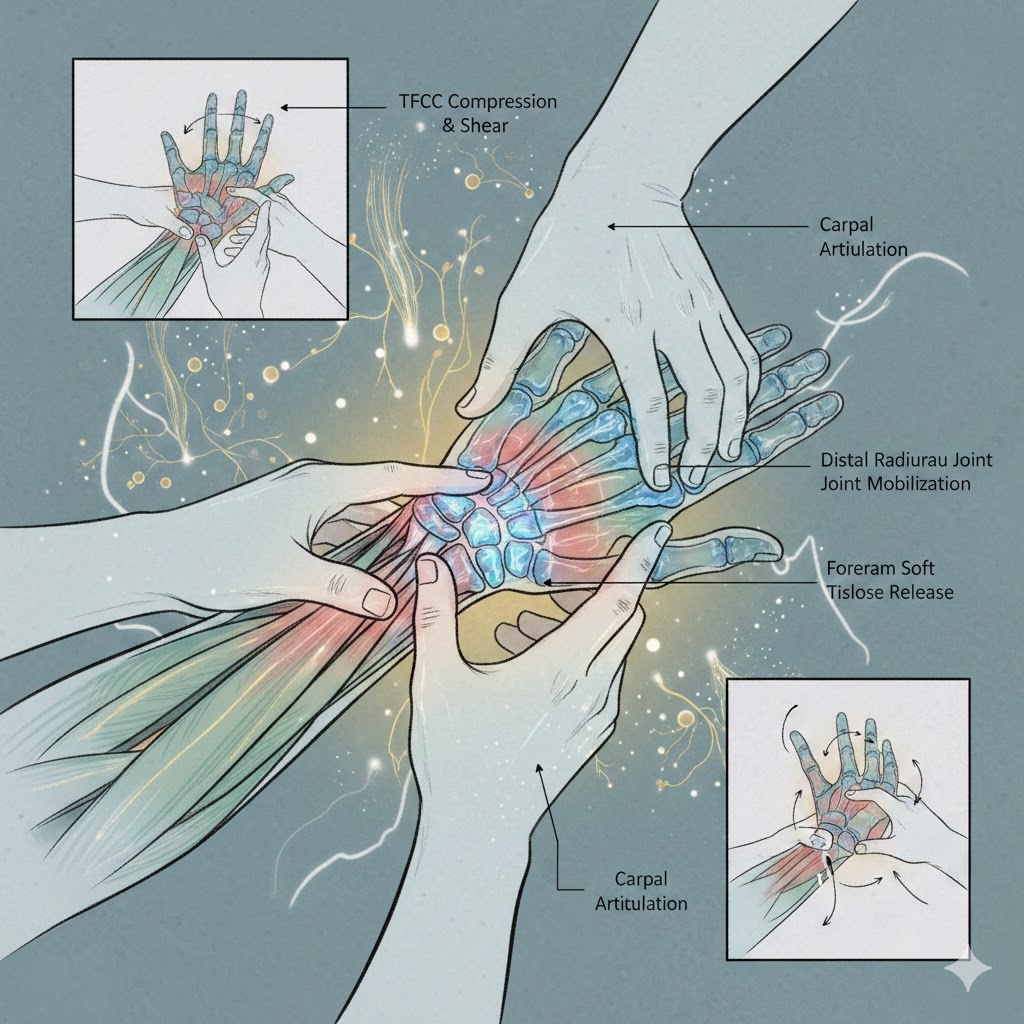
1. Understanding the Injury Through an Osteopathic Lens
Osteopathic practitioners believe structure and function are closely related. If the wrist hurts, it may be because of a local injury, but it may also be because of tension, restriction, or imbalance elsewhere.
For TFCC injuries, the practitioner examines:
-
Wrist alignment and motion
-
Forearm muscle tone and rotational balance (pronation/supination)
-
Elbow mechanics
-
Shoulder girdle position
-
Neck tension affecting nerve and muscle supply
-
Thoracic mobility affecting upper limb coordination
-
Postural habits that overload the wrist
ARTS (Asymmetry, Restriction, Tissue Texture, Sensory changes), the practitioner identifies areas contributing to pain and instability.
Osteopathic logic says: Fix what feeds the problem, not just the painful spot.
2. Goals of Osteopathic Management
The goals remain simple and patient-centered:
-
Reduce pain and irritation around the TFCC
-
Restore smooth wrist and forearm motion
-
Improve joint stability and neuromuscular control
-
Normalize mechanics of the entire upper extremity
-
Reduce strain patterns so the TFCC can heal naturally
Because the TFCC has limited blood supply—especially in its central part—creating a healthy, low-stress environment is essential for healing.
3. Osteopathic Manual Techniques Used in TFCC Management
Osteopathic treatment is tailored to each patient. Below are common techniques applied for TFCC-related pain:
These techniques reduce muscle guarding, improve circulation, and decrease inflammation.
Myofascial release for forearm extensors, flexors, and the interosseous membrane
Fascial unwinding around the ulnar side of the wrist
Trigger point therapy for muscle knots in the forearm
Effleurage and lymphatic strokes to reduce wrist swelling
These methods help loosen tight tissues that may be pulling the wrist out of alignment or stressing the TFCC during movement.
B. Muscle Energy Techniques (MET)
MET restores balanced muscle tone around the wrist and forearm.
Restricted pronation/supination
Radial-ulnar imbalance
Tight or overactive forearm muscles
These techniques improve joint mechanics and reduce abnormal force through the TFCC.
Gentle oscillatory movements help reset joint motion. Important areas include:
Radiocarpal joint
Distal radioulnar joint (DRUJ)
Intercarpal joints
Elbow (especially the radial head)
Shoulder and clavicle
Restoring mobility in these joints reduces compensatory movement patterns that overload the TFCC.
Counterstrain is used when wrist muscles are extremely tender and reactive. The practitioner finds a tender point and positions the wrist in a pain-free, shortened position. Holding this position resets muscle spindle activity and reduces protective tension.
This method works especially well for acute or irritated TFCC injuries where forceful treatment is not appropriate.
These techniques are uniquely suited for TFCC injuries because they:
Use extremely gentle force
Work directly with ligament tension
Encourage natural rebalancing of strained tissues
The practitioner delicately moves the wrist until tension in all tissues around the TFCC is balanced. This allows microcirculation, reduces pain, and encourages healing without stressing the injury.
Although seemingly far from the wrist, craniosacral techniques help regulate the nervous system, reduce overall muscle tension, and improve fluid exchange. This can indirectly improve healing in TFCC injuries by calming the body and reducing sympathetic overdrive.

4. Addressing Contributing Factors Outside the Wrist
Osteopathic care is never limited to the local site of injury. TFCC issues often have contributing factors elsewhere:
If the radial head is restricted, the radius cannot rotate properly. The wrist compensates, placing excessive pressure on the TFCC.
Mobilizing the radial head improves forearm rotation and reduces TFCC strain.
Rounded shoulders, tight pectoral muscles, or a depressed scapula alter the tension transmitted down the arm.
Correcting shoulder and scapular motion restores better load distribution from the hand to the body.
Neck restrictions can create abnormal nerve signals or muscle tone changes in the forearm and wrist.
Treating the cervical segments (often C5–T1) improves overall upper-extremity coordination.
Restoring thoracic and rib mobility ensures the wrist is not compensating for problems upstream.
5. Osteopathic Rehabilitation Plan
Beyond manual therapy, osteopathic management includes exercises and lifestyle adjustments.
The focus is on muscles that support the wrist without compressing the TFCC:
-
ECU (extensor carpi ulnaris) stability training
-
Grip conditioning using light resistance
-
Forearm rotation control exercises
-
Proprioceptive work like ball rolling or wobble board for the wrist
These exercises help protect the TFCC long-term.
Osteopathic practitioners educate patients on:
-
Neutral wrist position
-
Avoiding prolonged gripping
-
Adjusting keyboard or mouse height
-
Avoiding weight-bearing on the ulnar side
Small daily changes greatly reduce TFCC irritation.
Patients are guided to temporarily avoid:
-
Push-ups
-
Heavy lifting
-
Forceful twisting
-
Racquet sports
-
Weight-bearing yoga poses
These actions can be gradually reintroduced once stability is restored.
6. Expected Recovery Timeline
Recovery depends on severity, but osteopathic care aims to enhance natural healing.
Typical timelines:
-
Mild strain: 4–6 weeks
-
Mild tear: 6–10 weeks
-
Moderate tear without surgery: 2–3 months
-
Post-surgical osteopathic rehab: 3–6 months
Osteopathic care can significantly reduce pain even early in treatment because it addresses both local and global dysfunctions.
7. Conclusion
TFCC injuries are painful and frustrating because the wrist is involved in nearly every daily task. Osteopathic management offers a whole-body approach that restores balance, reduces stress on the injured tissues, and improves long-term wrist stability. By combining gentle manual therapy, movement correction, rehabilitation, and posture education, osteopathic treatment supports the body’s natural ability to heal while preventing the injury from recurring.
8. References
- Atzei A, Luchetti R. Foveal TFCC injuries: Classification and arthroscopic repair. Hand Clinics. 2011;27(3):263–272.
- Palmer AK. Triangular fibrocartilage complex lesions: A classification. Journal of Hand Surgery. 1989;14(4):594–606.
- Bednar JM, Arnoczky SP, Weiland AJ. The microvasculature of the TFCC. Journal of Hand Surgery. 1991;16(6):1101–1105.
- Calfee RP, Hsu JH. TFCC injuries: Diagnosis and treatment. Journal of Hand Surgery. 2010;35(4):689–698.
- Dutton M. Orthopaedic Manual Therapy: Diagnosis, Theory, and Practice. McGraw-Hill Medical; 2012.
- Chaitow L, DeLany J. Clinical Application of Neuromuscular Techniques. Elsevier; 2011.
- Greenman PE. Principles of Manual Medicine. 3rd ed. Lippincott Williams & Wilkins; 2003.
- Fryer G. Muscle energy technique: A literature review. International Journal of Osteopathic Medicine. 2016;20:3–11.
- Fernandez-de-Las-Peñas C, et al. Myofascial trigger points and musculoskeletal pain. Current Pain and Headache Reports. 2006;10:412–418.
- Donahue RP, Lister GD. Distal radioulnar joint and TFCC biomechanics. Hand Clinics. 2015;31(2):179–189.
- American Academy of Orthopaedic Surgeons (AAOS). TFCC injury clinical overview. OrthoInfo. 2020. Visit
- Millard B, Brault J. Manual therapy for wrist and hand disorders. Journal of Manual & Manipulative Therapy. 2013;21(2):99–108.
- Bohlen M. Rehabilitation of TFCC injuries: A clinical perspective. Hand Surgery & Rehabilitation. 2018;37(4):232–239.
- Zaidman M, Amir H. Role of proprioception in wrist joint stability. Clinical Biomechanics. 2015;30(7):630–635.
- Willard FH, et al. Fascia and tensegrity concepts in manual therapy. Journal of Bodywork and Movement Therapies. 2017;21(3):502–514.
- DiGiovanni BF. Distal radioulnar joint instability. Hand Clinics. 1995;11(3):389–398.
- Stecco C. Functional Atlas of the Human Fascial System. Elsevier; 2015.
- Kuchera ML, Kuchera WA. Osteopathic Principles in Practice. Greyden Press; 1994.
- Pedowitz DI, et al. Ulnar-sided wrist pain: Evaluation and management. Journal of Hand Surgery. 2012;37(10):2215–2224.
- Werner FW, et al. Load transmission across the wrist joint: Effects of TFCC injury. Journal of Hand Surgery. 2012;37(11):2326–2331.