Idiopathic winged scapula involves scapular medial border protrusion without clear trauma or nerve injury. It impairs shoulder stability and overhead function. Postural imbalance and muscular inhibition may contribute. Diagnosis is clinical. Osteopathic management—including myofascial release, neuromuscular re-education, mobilization, and strengthening—can help restore scapular control and reduce compensatory strain.
Introduction
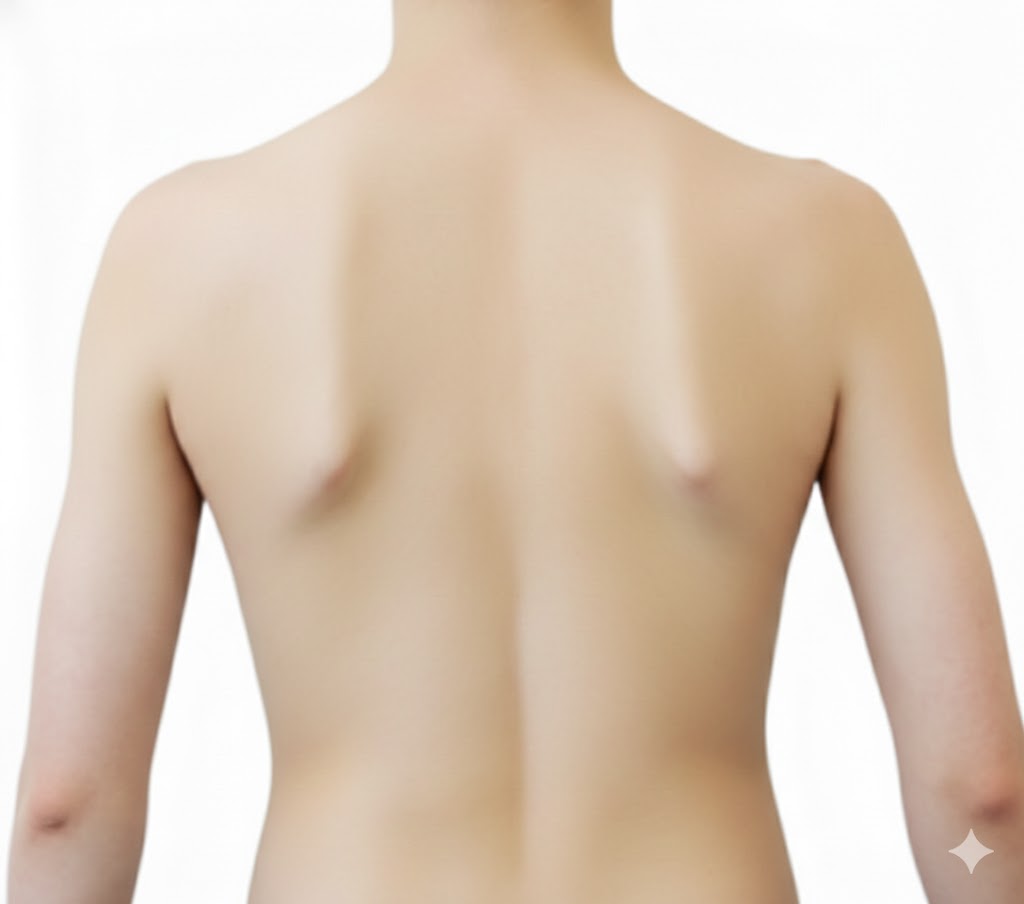
Idiopathic winged scapula, also known as scapula winging refers to scapular prominence and instability occurring without a clearly identifiable traumatic, neurological, or structural cause. While scapular winging is commonly linked to serratus anterior paralysis from long thoracic nerve (LTN) injury or trapezius dysfunction, the idiopathic form represents a distinct clinical challenge, as the underlying etiology is often subtle or multifactorial (1). Characterized by the medial border of the scapula protruding from the thoracic wall, idiopathic winged scapula can impair shoulder function, reduce strength, and cause chronic discomfort. This review details the current understanding of idiopathic winged scapula, including etiology, biomechanics, clinical presentation, diagnosis, conservative care, osteopathic management, and research implications.
Etiology and Pathophysiology
Idiopathic winged scapula lacks a clear precipitating event, but emerging evidence suggests a combination of subclinical nerve irritation, microtrauma, muscular imbalance, or postural dysfunction may contribute (2,3). Although traditionally assumed to be related to unrecognized LTN neuropathy, many idiopathic cases display normal electromyographic findings (4).
Possible mechanisms include:
1. Postural Dysfunction and Muscular
Imbalance
Forward-head posture and rounded shoulders
may place chronic load on the serratus anterior and lower trapezius, leading to
inhibition and scapular dyskinesis (5).
2. Subclinical Neuritis
Some patients show mild, transient irritation of the LTN after viral illness or repetitive strain, but without significant EMG abnormalities (1,4).
3. Scapulothoracic Fascia Dysfunction
Altered fascial tension in the thoracic region may disrupt proprioceptive input or change muscle activation patterns, contributing to instability (6).
4. Developmental or Anatomical Variations
Variations in scapular shape, rib prominence, or muscle fiber length may predispose certain individuals to scapular prominence under load (7).
Idiopathic winging is therefore considered a functional, rather than structural, condition, often arising from subtle dysfunction rather than overt nerve damage.
Biomechanics
The scapula plays a fundamental role in shoulder mechanics, acting as a dynamic base for humeral motion (5,8). Proper scapular positioning requires coordinated activity of serratus anterior, upper and lower trapezius, rhomboids, and levator scapulae. When serratus anterior activation is reduced—even without denervation—the scapula fails to protract and upwardly rotate effectively, resulting in medial winging.
Key biomechanical features of idiopathic winged scapula include:
- Impaired scapular upward rotation
- Reduced posterior tilt
- Excessive downward rotation from overactive levator scapulae
- Delayed serratus anterior activation during elevation (5)
These changes lead to compensatory overuse
of the upper trapezius, altered glenohumeral rhythm, and potential secondary
rotator cuff weakness.
Clinical Presentation
Patients with idiopathic winged scapula typically present with:
- Visible medial border prominence during arm flexion or wall
push-up
- Shoulder fatigue, especially during overhead tasks
- Periscapular pain or a pulling sensation
- Difficulty lifting or pushing objects
- Poor posture and forward shoulders
- Reports of instability or “looseness” around the shoulder girdle
Unlike traumatic or neuropathic winging,
idiopathic cases are often mild to moderate, intermittent, and variable
depending on fatigue level or posture (2,4).
Diagnosis
Idiopathic winged scapula is a diagnosis
of exclusion. A complete evaluation includes:
1. Clinical Examination
Observation during shoulder motion, wall
push-up tests, and resisted scapular movements helps characterize the winging
pattern (1,3).
2. Neurological Assessment
LTN and SAN function should be assessed. Idiopathic cases typically show:
- normal neurological exam
- preserved muscle bulk
- non-progressive symptoms
3. Electromyography (EMG)
EMG is used to rule out LTN neuropathy.
Idiopathic cases usually display normal or near-normal findings (4).
4. Imaging
Ultrasound or MRI may be used to exclude
structural lesions or significant muscle atrophy (9).
5. Postural Assessment
Forward-head posture, thoracic kyphosis,
and rib dysfunction are frequently contributing factors (5,6).
Conservative Management
Idiopathic winged scapula responds well to non-surgical
care, with rehabilitation and movement retraining forming the cornerstone
of treatment.
1. Postural Correction
Targeting thoracic extension, cervical
alignment, and scapular retraction reduces load on stabilizing muscles (5).
2. Strengthening of Scapular Stabilizers
Key muscles include:
- Serratus anterior (serratus punches, wall slides, dynamic hugs)
- Lower trapezius (Y-raises, prone retraction)
- Rhomboids and mid trapezius
- Rotator cuff (particularly external rotation)
3. Scapular Motor Control Training
Exercises emphasize timing, sequencing, and
coordination, rather than brute strengthening alone.
4. Avoidance of Aggravating Movements
Temporarily reducing push-ups, heavy
overhead lifting, or repeated protraction/traction prevents further irritation
(1).
5. Pain Management
Soft-tissue therapy, kinesiotaping, and
NSAIDs can help reduce symptoms during early rehabilitation (3).
Osteopathic Management
Osteopathy offers a biomechanically oriented approach particularly suited for idiopathic cases, which often involve functional rather than structural pathology.
1. Myofascial Release (MFR)
Targets hypertonic regions commonly involved in idiopathic winging:
- pectoralis minor
- upper trapezius
- levator scapulae
- rhomboids
- latissimus dorsi
MFR improves scapulothoracic glide and reduces restrictive fascial tension (6).
2. Muscle Energy Technique (MET)
MET can address:
- thoracic rotation restrictions
- rib dysfunction (especially ribs 2–7)
- postural asymmetries
Correcting rib mobility is beneficial due to serratus anterior origin points (3).
3. Articulatory and HVLA Techniques
Improved thoracic spine mobility supports optimal scapular motion. HVLA may be used selectively when safe and appropriate (8).
4. Proprioceptive Neuromuscular
Re-education
OMT combined with corrective exercise enhances neuromuscular recruitment, especially for serratus anterior and lower trapezius.
5. Respiratory and Diaphragmatic
Techniques
Dysfunctional breathing patterns can alter thoracolumbar mechanics and scapular mobility; thoracic inlet release and diaphragm release help integrate breathing with scapular motion (6).
6. Patient Education
Focus areas include:
- ergonomics
- sleep posture
- scapular setting techniques
- daily micro-breaks
Prognosis
Idiopathic winged scapula generally has a
favorable prognosis. With structured rehabilitation and osteopathic care, most
individuals experience significant functional improvement within 3–12 months
(2,4). Persistent cases typically involve deeper postural dysfunction or
chronic motor-pattern deficits that benefit from long-term neuromuscular
training.
References
(1) Martin RM, Fish DE. Scapular winging:
anatomical review, diagnosis, and treatments. J Bone Joint Surg Am.
2008;90(8):2014–2024.
(2) Fiddian NJ, King RJ. The winged scapula. Clin Orthop Relat Res.
1984;(185):228–236.
(3) Kuhn JE, Plancher KD, Hawkins RJ. Serratus anterior dysfunction and
scapular winging. J Am Acad Orthop Surg. 1995;3(6):319–325.
(4) Tadi P, Varacallo M. Long thoracic nerve palsy. StatPearls. 2023.
(5) Kibler WB, McMullen J. Scapular dyskinesis and its relation to shoulder
injury. J Am Acad Orthop Surg. 2003;11:142–151.
(6) Stecco C, et al. The fascial system and shoulder function. J Bodyw Mov
Ther. 2014;18:380–390.
(7) Meininger AK, et al. Scapular winging: anatomical review, diagnosis, and
treatment. Curr Rev Musculoskelet Med. 2011;4:1–11.
(8) Ludewig PM, Cook TM. The effect of scapular motion on shoulder impingement.
J Orthop Sports Phys Ther. 2000;30:57–70.
(9) Martinoli C, et al. Ultrasound evaluation of peripheral nerves. Radiol
Med. 2013;118:215–231.
(10) Inman VT, Saunders JB, Abbott LC. Observations on the function of the
shoulder. J Bone Joint Surg Am. 1944;26:1–30.