How to Do the "Fly Bird" Prone Extension Exercise
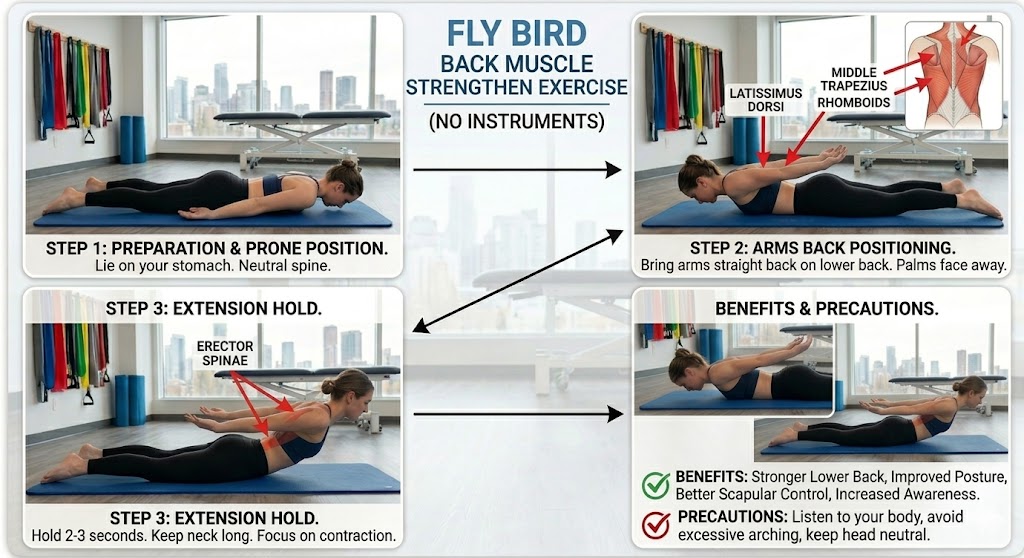
The "Fly Bird" exercise shown in the infographic is a prone (lying on your stomach) back-extension movement designed to strengthen the posterior chain without using any equipment.
Here is how to perform it step-by-step:
Step 1: The Setup (Prone Position) Lie flat on your stomach on a comfortable exercise or yoga mat. Keep your legs straight behind you and your forehead resting gently toward the floor to maintain a long, neutral neck. Place your arms down by your sides, resting next to your hips.
Step 2: Arm and Palm Positioning Bring your straight arms slightly back and lift them just above your lower back. Your palms should face up toward the ceiling. Keep your elbows locked and your fingers extended.
Step 3: The Extension and Hold Engage your core and squeeze your glutes. Inhale as you slowly lift your chest, shoulders, and upper ribs off the mat. At the same time, reach your straight arms back and upward toward the ceiling, keeping your palms facing up like a bird spreading its wings in mid-flight.
Step 4: Return with Control Hold the lifted, contracted position for 2 to 3 seconds while maintaining a steady breath. Do not crank your neck upward; keep your gaze toward the floor. Slowly lower your upper body back down to the starting position with control. Repeat for 2 to 3 sets of 10–12 repetitions.
Key Benefits of Doing This Exercise
This exercise is highly regarded in osteopathy and physical therapy for its ability to target deep, structural postural muscles safely:
Strengthens Spinal Extensors: It heavily targets the erector spinae (the muscles running parallel along your spine), building the muscular endurance needed to hold your body upright effortlessly throughout the day.
Corrects Slouching and "Forward Head" Posture: By forcing you to retract your shoulder blades and lift your chest, it strengthens the middle trapezius and rhomboids. This acts as a counter-stretch to the rounded-shoulder posture caused by looking at computers and phones.
Safely Stabilizes the Lower Back: Because your lower body remains anchored to the floor, this exercise provides a controlled environment to strengthen the lower back and lower thoracic spine without exposing the vertebrae to dangerous rotational forces or heavy spinal compression.
Improves Scapular and Shoulder Health: Reaching back with the palms facing up opens up the chest musculature (pectorals) while actively engaging the posterior deltoids and lower traps, improving the overall mobility and stability of the shoulder girdle.