Spinal stenosis is a condition characterized by narrowing of the spinal canal, lateral recesses, or intervertebral foramina, resulting in compression of the spinal cord, nerve roots, or cauda equina.2,13 It most commonly affects the lumbar spine and is one of the leading causes of pain, disability, and spinal surgery among older adults.1,7,9
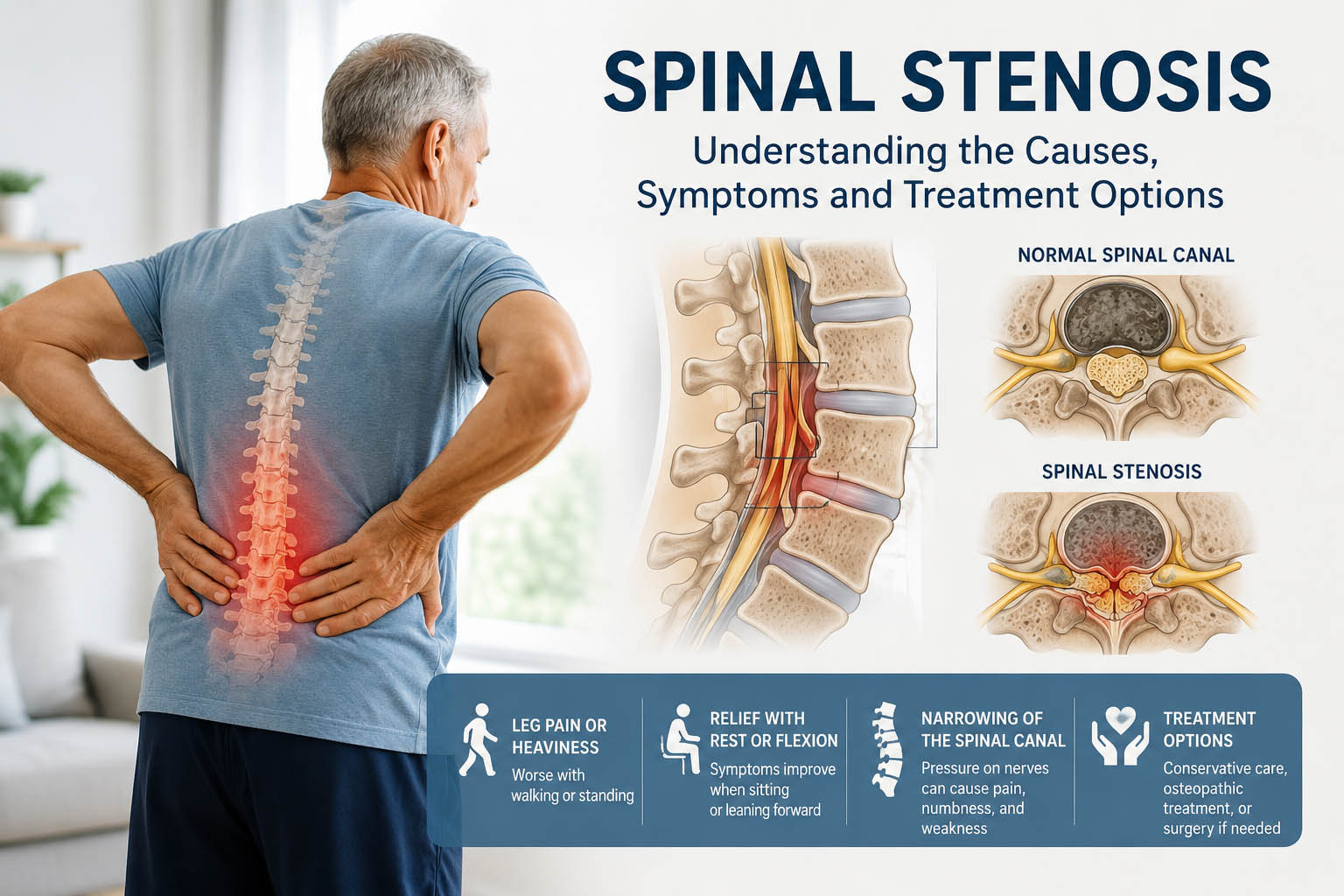
Although spinal stenosis may occur in the cervical, thoracic, or lumbar regions, lumbar spinal stenosis is by far the most prevalent form encountered in clinical practice.1,6 As populations age worldwide, the number of individuals affected by spinal stenosis continues to rise, making early recognition and appropriate management increasingly important.9,15
Etiology of Spinal Stenosis
The most common cause of spinal stenosis is age-related degeneration of the spine.1,11 Degenerative changes gradually reduce the available space within the spinal canal and neural foramina. These changes may include intervertebral disc degeneration, facet joint osteoarthritis, hypertrophy of the ligamentum flavum, osteophyte formation, and vertebral instability.1,15
Additional contributing factors include spondylolisthesis, scoliosis, spinal trauma, postoperative scarring, inflammatory arthropathies, tumors, and metabolic bone disorders.2,4,12 In some cases, stenosis may affect multiple spinal regions simultaneously, a condition known as tandem spinal stenosis.14
Symptoms of Spinal Stenosis
Lumbar spinal stenosis commonly presents with lower back pain, buttock discomfort, leg pain, numbness, tingling, weakness, and reduced walking tolerance.1,13 The hallmark symptom is neurogenic claudication, characterized by pain, heaviness, fatigue, or weakness in the legs during standing or walking.18
Cervical spinal stenosis may produce neck pain, upper extremity numbness, hand clumsiness, balance impairment, gait disturbances, and signs of cervical myelopathy.2 Thoracic spinal stenosis is less common but may result in trunk pain, lower extremity weakness, sensory changes, and gait dysfunction.12
Diagnosis of Spinal Stenosis
Diagnosis begins with a comprehensive clinical history and physical examination.17 Particular attention should be given to symptom patterns, aggravating and relieving factors, walking tolerance, neurological complaints, and functional limitations.
Physical examination may reveal restricted spinal mobility, postural adaptations, altered gait patterns, muscle weakness, sensory disturbances, diminished reflexes, and balance deficits.18 However, objective findings may be surprisingly limited despite significant symptoms.
Computed tomography (CT) may be useful when MRI is contraindicated or when detailed evaluation of bony structures is required.2 Plain radiographs may identify degenerative changes, scoliosis, spondylolisthesis, and spinal alignment abnormalities but are less sensitive for direct assessment of stenosis.4
Differential diagnosis includes peripheral vascular disease, hip osteoarthritis, peripheral neuropathy, lumbar disc herniation, sacroiliac dysfunction, and other causes of lower extremity pain.18
Treatment of Spinal Stenosis
Exercise programs typically focus on improving spinal mobility, flexibility, core stability, lower extremity strength, and aerobic conditioning. Flexion-based exercises are frequently beneficial because they may temporarily increase spinal canal dimensions and reduce symptoms.1
Surgical intervention may be considered when conservative care fails or when progressive neurological deficits develop. Common surgical procedures include decompressive laminectomy, laminotomy, foraminotomy, and spinal fusion when instability is present.7,10 The primary goal is to decompress neural tissues and improve functional capacity.
Osteopathic Assessment and Treatment for Spinal Stenosis
Osteopathic assessment focuses on identifying biomechanical factors that may contribute to pain, altered movement patterns, and functional limitations associated with spinal stenosis. Evaluation typically includes postural analysis, gait assessment, spinal mobility testing, pelvic alignment assessment, muscular balance evaluation, and examination of regional compensatory patterns.
Patients with spinal stenosis often develop protective postures characterized by forward trunk flexion, reduced lumbar extension, restricted hip mobility, and compensatory thoracic or cervical adaptations. Osteopathic practitioners evaluate the entire musculoskeletal system rather than focusing solely on the symptomatic spinal segment.
Osteopathic treatment does not aim to reverse anatomical narrowing of the spinal canal. Instead, treatment seeks to optimize biomechanical function, reduce secondary tissue strain, improve mobility, enhance circulation, decrease muscular tension, and support overall movement efficiency.
Common osteopathic approaches may include gentle soft tissue techniques, myofascial release, muscle energy techniques, articulatory techniques, balanced ligamentous tension techniques, and mobility-focused rehabilitation exercises. Treatment may be directed toward the lumbar spine, pelvis, hips, thoracic spine, lower extremities, and associated fascial structures.
Exercise prescription is an important component of osteopathic management. Individualized programs may incorporate flexion-biased spinal movements, hip mobility exercises, postural retraining, core stabilization, gait retraining, and functional strengthening activities. Patient education regarding pacing strategies, body mechanics, and activity modification is also essential.
Many individuals experience improved comfort, enhanced mobility, and better functional tolerance when osteopathic care is integrated with exercise therapy and appropriate medical management. A collaborative, multidisciplinary approach often provides the best long-term outcomes.
Conclusion
Spinal stenosis is a common degenerative condition that becomes increasingly prevalent with age. While structural narrowing of the spinal canal may be present without symptoms, clinically significant stenosis can lead to pain, neurogenic claudication, neurological deficits, and substantial functional impairment. Accurate diagnosis requires correlation between clinical findings and imaging studies. Conservative management remains the first-line treatment for most patients, while surgery may be appropriate in selected cases. Osteopathic assessment and treatment can play a valuable supportive role by addressing biomechanical dysfunctions, improving movement quality, and helping patients maintain function and quality of life.
References
3. Babb A, Carlson WO. Spinal stenosis. S D Med. 2006;59(3):103-105.
4. Kim SL, Lim RD. Spinal stenosis. Dis Mon. 2005;51(1):6-17. doi:10.1016/j.disamonth.2004.12.003.
5. Garfin SR, Rauschning W. Spinal stenosis. Instr Course Lect. 2001;50:145-152.
6. Ciricillo SF, Weinstein PR. Lumbar spinal stenosis. West J Med. 1993;158(2):171-177.
10. Garfin SR, Herkowitz HN, Mirkovic S. Spinal stenosis. Instr Course Lect. 2000;49:361-374.
11. Lipson SJ. Spinal stenosis. Rheum Dis Clin North Am. 1988;14(3):613-618.